ARA independent product stocks fall

London, 11 October (Argus) — Oil product stocks held in independent storage within the Amsterdam-Rotterdam-Antwerp (ARA) trading hub fell by 2.4pc from a week earlier, largely as a result of a significant drop in fuel oil volumes. Stock levels of other products were broadly stable.

Fuel oil stocks fell by 17.3pc to 1.03mn t, prompted by the loading and departure of several cargoes during the week to today. The Max Jacob, booked by Litasco to ship 130,000t of HSFO to Singapore loaded on 4 October and headed eastbound. The South Sea, booked by P66 to ship 130,000t of cracked fuel oil from Rotterdam to Singapore, likely started loading on 11 October. Tankers also left the ARA area for west Africa and the Mideast Gulf. Arbitrage economics to take high-sulphur material from northwest Europe to Asia Pacific strengthened in the past week. The Singapore second-month 380cst swap premium to HSFO cargo prices in northwest Europe averaged $33/t on 4-10 October, compared with an average spread of $29.70/t during the prior five trading days. A total of 430,000t of fuel oil was booked to Singapore this week.

Gasoline stocks fell by 25,000t to 1.06mn t, with outflows being supported by efforts to sell off stored summer-grade volumes. Cargoes arrived in the ARA area from Finland, Spain and the UK. Tankers left the area for the Mideast Gulf, Brazil, Latin America and the Mediterranean. Naphtha stocks fell by 11,000t to 341,000t, prompted by steady demand from inland petrochemical end-users and low volumes arriving in the area. Tankers arrived from Algeria, France and Portugal, and none were seen departing.

Stocks of gasoil rose by 102,000t to 3.04mn t, the highest level since mid-February 2018. Tankers arrived in the ARA area from Russia and Saudi Arabia, and departed for France, the Mediterranean and the UK. Low water levels on the river Rhine continued to impact barge traffic into Germany and France, bolstering interest in other forms of product transport. Cargo freight rates from the ARA continued to rise as a result, with some operators preferring to move material inland via other coastal outlets.

A single jet kerosene cargo arrived in the ARA area during the week to 11 October and a single tanker left for the UK. Inventories were effectively unchanged on the week at 674,000t. The Raysut partially offloaded in Rotterdam following a partial deposit into Fawley. The vessel had been sitting in the English Channel since 18 June, as the buyer was exercising some of its contract options by waiting to offload. Northwest European jet fuel demand has fallen since last week. Imports from east of Suez have been thin, with most arrivals entering UK and French ports.

Reporter: Thomas Warner
GREATER SINGAPORE TANK STORAGE MARKET OUTLOOK 2018 – PART 1

As one of the most crucial tank storage hubs in the world, Singapore and nowadays the greater Singapore region play a fundamental role in global trade.

Far East and the ISC countries have experienced tremendous economic growth over the past decades, and this upward trend even has had an impulse after the global financial crisis in 2008.  Going forward, trade imbalances, regulations and newly build capacity will continue to influence opportunities in the tank terminal industry in the greater Singapore region.

REGIONAL DEMAND FOR OIL PRODUCTS REMAINS STRONG

The continuously growing economies have driven supply and demand for oil products in Asia, with the Indian and especially Chinese economy increasing their production substantially. China, India, Japan and South Korea are the region’s largest suppliers of oil products, with China more than doubling any other country’s output in 2017.

Far East and the ISC refinery output primarily consists of diesel and gasoline, accounting for 44% and 26% of the region’s total output in 2017 respectively. The productions of both products grew rapid over the past decade, more than any other main refinery output, while demand for both products in the region has increased gradually over the last decade.

Far East and the ISC has surplussus of diesel, gasoline and jet-kerosene, meaning it produces more than it consumes of these products. A higher surpluss generally leads to higher exports of a product, implying an increased demand for temporary tank storage capacity. Deficits exist for fuel oil, naphtha and LPG, meaning Far East and the ISC has to import these products from outside of the region.  Singapore’s tank terminal industry has been benefiting from this situation for a long time.

SINGAPORE ON ALERT AS NEIGHBORS’ TANK STORAGE MARKET SHARE INCREASES

Malaysia and Indonesia aim at increasing their market share both approaching Singapore’ total tank storage capacity, while Singapore stays on alert with only minor expansions.

Singapore has been the largest provider of tank capacity in the Greater Singapore area and has roughly tripled its capacity since 2005, especially during the prolonged period of contango between 2005 and 2011, which supported demand for tank capacity. Market circumstances were less favorable after 2011, but the construction of new capacity had already begun adding new storage tanks after this date.

Malaysia is expected to almost double its capacity in 2018 with 4,900,000m3, while in Singapore a total of 370,000 m3 or a mere 2% of its total capacity is being constructed as of 2018. Indonesia has no capacity that is noteworthy under construction but has plans to add more than 7 million m3 in the future. This expansion would more than double the country’s total capacity, but whether these plans will be executed is uncertain.

Singapore will therefore primarily see increased competition from Malaysian tank storage operators.

PREPARING FOR A NEW SET OF CHALLENGES

The Tank Terminal industry in the Greater Singapore area is facing some new challenges, such as new restrictions on emissions, IMO 2020’s new bunker fuel specifications and logistical developments in Asia.

Environmental regulations will  have a downforce to gasoline and diesel demand in the region, changing national imbalances and thus trade flows.  A sharp decline in fuel oil demand as of 2020 on the other hand, will increase marine gasoil demand, which will result in less temporary storage of fuel oil in Singapore and increase the demand for temporary storage of marine gasoil.

There may also be pressure on demand for marine bunkering and temporary oil products storage in Singapore when alternative cargo routes replace the Strait of Malacca. These could include new One Belt One Road trade routes and China’s two Ocean’s strategy via pipelines through Myanmar.

Click here to read Part 2 of the article “Greater Singapore Tank Storage Market Outlook 2018”.

SINGAPORE TANK TERMINAL MARKET STUDY 2018

Based on extensive market research, Insights Global – in partnership with Ener8 Limited – has produced a +75 pages report providing insights into the Tank Terminal Market in both Singapore and the greater Singapore area.

Click here to download the table of contents

For more information on how to purchase this report please contact info@insights-global.com

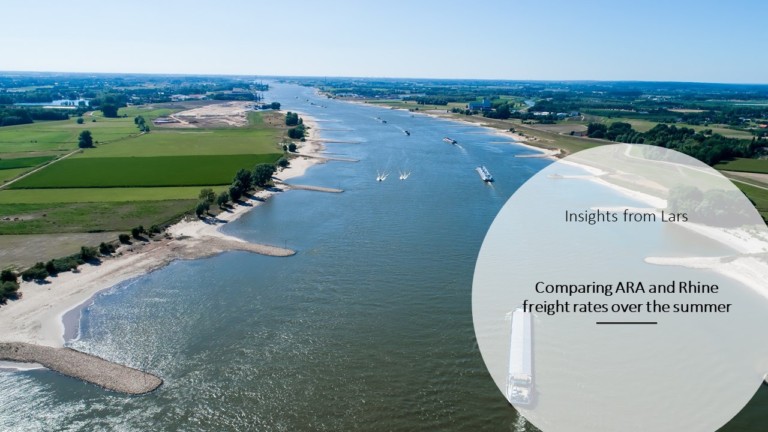
Insights from Lars – comparing ARA and Rhine freight rates over the summer.

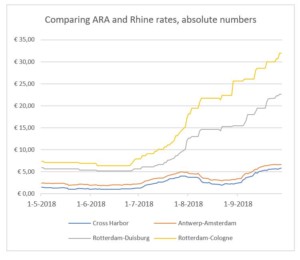
Freight rates in both the ARA region as well as on the Rhine remained strong, supported by increasing demand and the ongoing low water levels, which are hampering intakes. Freight rates for Rhine based destinations have not only risen for Middle and Upper Rhine destinations, where loaded volumes are contracted by low water levels up pegel Kaub, but also destinations in the German Ruhr area are highely affected. The difference between ARA-routes like Cross Harbor transports, Antwerp – Amsterdam and Rhine based tranports to Duisburg or Cologne are shown below.

In common situations, freight rates per mton are increasing in line with the voyage durations. The strong demand, and therefore increasing rates, to German markets are seen in the two graphs. Besides the absolute freight rates, a graph is made for indexed freight rates. The base rates of 1st of May 2018 are used for this calculation. After a slow late-spring, with low freight rates per ton, rates started to increase from July on. This has been accelerated by decreasing water levels and increasing demand for automotive fuels in hinterland markets. Rates to the Ruhr area, which are longer voyages compared to ARA-transports and are therefore priced at higher levels, saw a steady increase during the summer season. In August, a distinction is seen between demand in ARA, which was fading, and up the Rhine, which was supported by diesel transports.

Last month, rates up the Rhine increased further. Water levels continued to stay low and the market regained support from outages at various refineries in Germany. The maintenance season is causing less local supply and an unplanned outage at the Vohburg refinery in Bavaria is limiting product supply even further. Importers are looking at alternative outlets and more product needs to be imported to handle domestic demand. This is partly done over the Rhine, where barges are still coping with loading restrictions. Imports by barge have however increased by over 60% during September compared to the summer months, as was seen in PJK’s Rhine barge flow reports. By comparison, rates to Lower Rhine destinations have more than quadrupled in the last months. The revenue per barge is somewhat lower due to less loaded volumes, but are still elevated. This is also seen in the ARA, where supply of barges is lacking due to the higher demand in Germany.   The demand for importing product in the coming weeks could remain high since end consumers still need to stock up heating oils for the winter. This has been postponed last spring due to the backwardated market structure, so stock levels in hinterland are relatively low. With inadequate local production, low availability of barges and high freight rates, keeping track of the markets is vital in order to stay up to date.

If you would like more information about our products like the Rhine flow service, barge freight rates and daily reports, contact our sales department in the Netherlands at +31 850 66 25 00 or at info@insights-global.com.

Oil derivatives market and tank storage markets

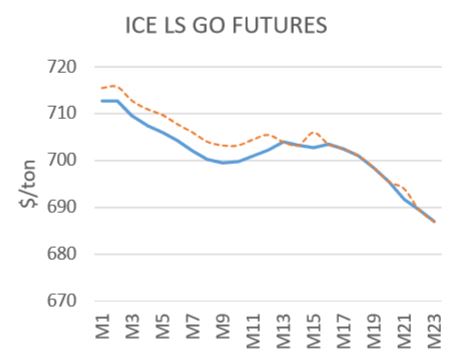
Tank terminals play a vital role in daily oil trading by enabling break and making bulk operations and balancing short term variations in supply and demand. Oil trading companies have an interest in renting tank storage capacity as the oil derivatives market is related to physical oil markets. For ARA oil products ICE gasoil futures are one of the most important trading tools to manage risk. In the image below you can see the ICE LS Go Futures graph.

The backwardation at the beginning of the gasoil curve decreased to to +$0.00 despite far higher spot prices, while the contango in the middle decreased substantially. Trading opportunities have therefore become harder to find.

As gasoil inventories in the region are higher pressure is put on local gasoil prices, while higher crude prices make refinery input more expensive. As a result, Brent crude crack spreads are weak and this could lead to lower output of local refiners. Currently the tank storage market is in backwardation, traders have no incentive to store gasoil and will minimize inventory levels. That is why the demand for storage capacity will decrease when the market is in backwardation.

Would you like to have a weekly update about the tank storage market ? Or get a better insight about the ARA region ? Contact us for more information and become familiar with our diverse services.

Access more than 4,900 independent tank terminals on our newly released platform. See for yourself by registering for our free trial.

ARA independent product stocks increase

London, 27 September (Argus) — Oil product stocks held in independent storage within the Amsterdam-Rotterdam-Antwerp (ARA) trading hub rose by 6.3pc from a week earlier because of large gains in fuel oil and gasoline inventories.

Fuel oil stocks rose by a fifth from a week earlier as product was put into storage to be loaded on two Singapore-bound VLCCs. One of these tankers — the Ridgebury Artois — has likely started loading fuel oil and could shortly leave for Singapore. No VLCCs left during the past week, while the Suezmax Sabine departed for Asia-Pacific with 130,000t of fuel oil. Bookings on the route to Singapore have picked up pace this week as export economics improved following a decline in Singapore’s inventories to multi-week lows. The ARA region imported fuel oil from the Black Sea, the Baltic Sea and Spain.

Gasoline stocks also rose, climbing by 10pc amid limited export options. US demand for gasoline has been weak since the conclusion of the summer driving season. This was reflected in last week’s increase in stocks, which came despite lower domestic production. During the week to 21 September, implied demand dropped to a 17 week low, and was also down year on year, according to EIA data. Exports to the Middle East are also likely to slow in the coming week as regional refineries come back from unplanned shutdowns. The ARA region exported gasoline to the Mideast Gulf and west Africa during the past week.

Lack of export options and comparatively low demand also led to an increase in naphtha stocks, which climbed 6pc from a week earlier. The European naphtha market is well-supplied, while demand from gasoline blenders is low. And arbitrage economics to Asia-Pacific are unworkable, largely because of ethylene cracker maintenance in that region. No naphtha was exported from the ARA region this week, while product arrived from Algeria, France, Spain and the UK.

And diesel inventories rose by less than 1pc this week. US diesel production also has fallen, which is likely to lead to a decline in exports to Europe in the coming weeks. In Europe, water levels on the Rhine remain low, keeping barge rates high and limiting inland shipments. The economics for importing diesel into Europe remain weak. But this could change if Rhine river water levels rise, allowing German demand to access ARA gasoil stocks, reducing supplies and pushing prices higher.

Jet fuel stocks bucked the trend, dropping by 14,000t, or 2pc because of comparatively high export volumes. The ARA region shipped the product to Denmark and the UK, while importing some jet fuel from the Mediterranean.

Quick insight ARA Tank Terminal capacity expansion

The ARA region is an important trading hub in Northwest Europe due to its infrastructure and fundamentals to serve the physical market for liquid trade. Location is key and ARA’s location is exceptional due to the Rhine river that connects with the Benelux countries, Switzerland, France and Germany. Also the ARA region provides refining facilities, tank storage and is seen as oil pricing center.

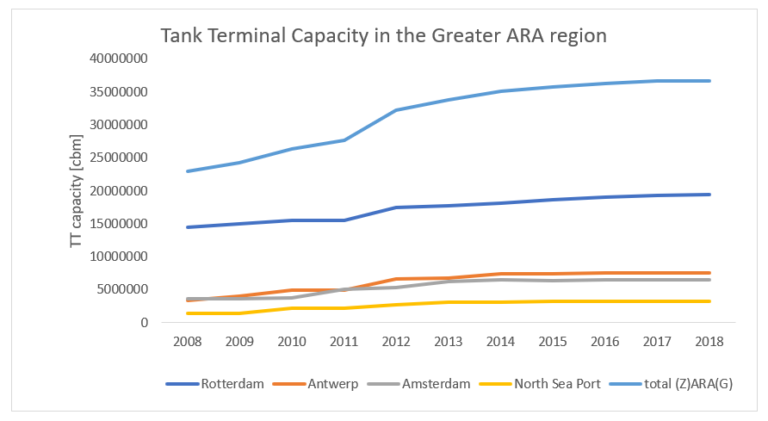
In the first image you can view the evolution of the tank terminal capacity in the greater ARA region. Important capacity additions in the past two years were done by Botlek Tank Terminals, Koole Tank Storage Minerals and NoordNatie Antwerp. At the same time we can observe various expansion activities in the ARA region, which will increase the current tank storage capacity further.

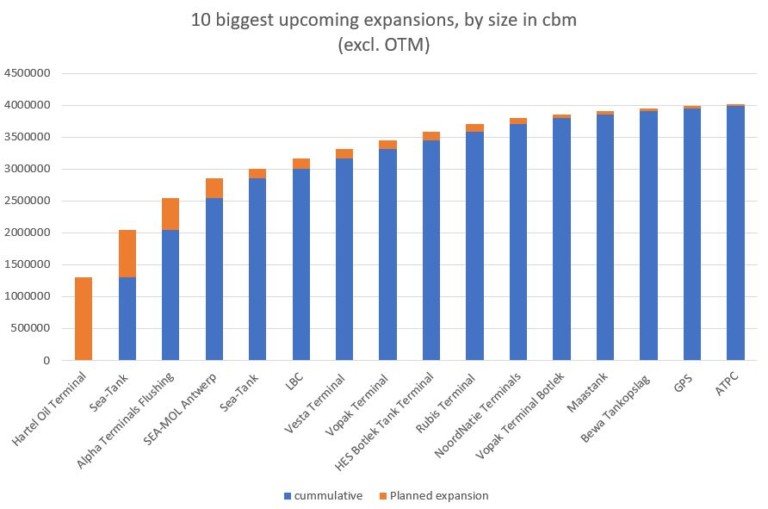
Secondly in the image below you can see the capacity under construction. Various players will also be adding capacity to their current storage capacity. The total amount of storage capacity under construction will be about 2.3% of current installed capacity and will be accessible in the coming years. Besides expansions , new terminals are expected to be built as well in various ports, focusing on liquid bulk like mineral oil products & petrochemicals.

We do expect some changes that might alter the ARA fuel oil market and petrochemical market and may therefor influence the tank storage market in those segments. Are you interested to get more information contact us at the headquarters in the Netherlands at +31 (0) 850 66 25 22.

ARA independent fuel oil stocks fall sharply

London, 20 September (Argus) — Oil products stored independently within the Amsterdam-Rotterdam-Antwerp (ARA) hub declined by nearly 2pc over the past week because of a large drop in fuel oil inventories.

Fuel oil stocks shed 143,000t — or 11.2pc — during the past week as imports of Russian fuel oil from the Baltic Sea continued to fall. The decline came despite challenging arbitrage economics to Singapore. No vessels bound for Asia-Pacific have loaded fuel oil from Rotterdam during the past week. The VLCC Ridgebury Artois, booked to ship 270,000t of fuel oil to Singapore earlier this month, has arrived in Rotterdam. Some fuel oil was exported to the Mediterranean to supply the local bunkering market and to the Middle East during the past week.

Jet fuel stocks also declined, but were down just 1pc week on week. The European market is generally well supplied, while demand has weakened following the conclusion of the peak summer flying season. But most of the product imported from east of Suez this week was discharged into ports in the UK. One vessel, the Polar Bright, chartered by BP, arrived into Rotterdam on 16 September with 90,000t of jet fuel from Ruwais, but has yet to offload this material.

Gasoil stocks rose by around 1pc during the past week. Inland shipments to the German market, which is affected by supply shortages, remained depressed because of low water levels on the Rhine. Transatlantic shipments of diesel have not fallen as much as expected by market participants in September from the prior month because of high US production and stocks. The Asian diesel market is tight, which is likely to draw diesel from the Mideast Gulf, reducing the amount of material available to be exported to Europe from that region.

Gasoline inventories also rose by around 1pc week on week. US demand for European gasoline has dropped following the conclusion of the summer driving season, but buying interest in west Africa and the Middle East remains firm, largely offsetting the impact of lower transatlantic shipments. The ARA region imported gasoline from Denmark, France, the Mediterranean and the UK in the past week.

Likewise, naphtha stocks rose marginally during the period, adding just 2,000t. Demand from gasoline blenders and the petrochemicals sector has softened during the past two weeks, keeping more product in storage. Some naphtha was shipped to Denmark, likely to use as a feedstock to produce gasoline.

A brief observation of the Northwest European markets and its place in the global naphtha supply chain.

Tank terminals play a vital role in current global markets. Their primary function is to physically balance supply and demand along the supply chain and to facilitate opportunities. The ARA region is the main trading hub within Northwest Europe due to its outstanding infrastructure, its network with many active market players and its place within the overall supply chain. We will take a closer look at the naphtha markets in this region and its importance for the international oil markets. Naphtha is retrieved from various sources like condensate gas, petroleum distillates or the distillation of tar and is mostly used in the gasoline blending and petrochemical markets.

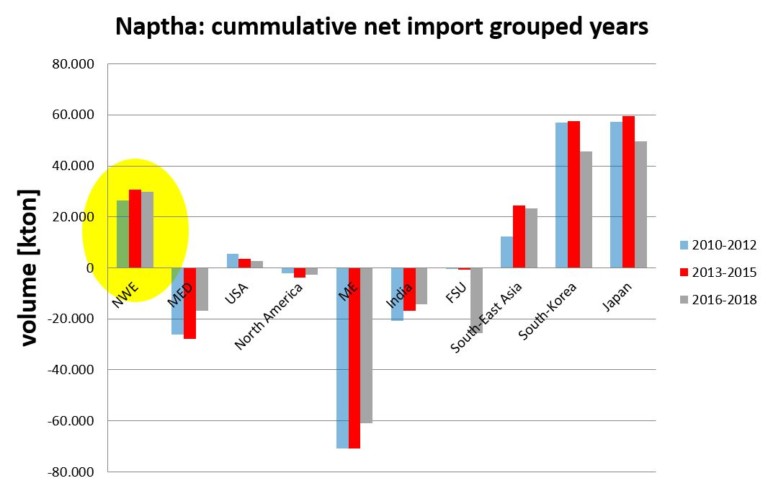
Within ARA, with the Port of Amsterdam being a gasoline blending hub, demand for naphtha is fairly high and it makes North West Europe net-importer for the product.Other regions like the Middle East , the Mediterranean and India are net-exporters which provide global trade flows of the product. Competition for import to North West Europe comes from petrochemical markets in East Asia, which are also big net-importers as seen in the top graph to the right. The imbalance between the supply and demand in the different regions provides trading opportunities in various ways.

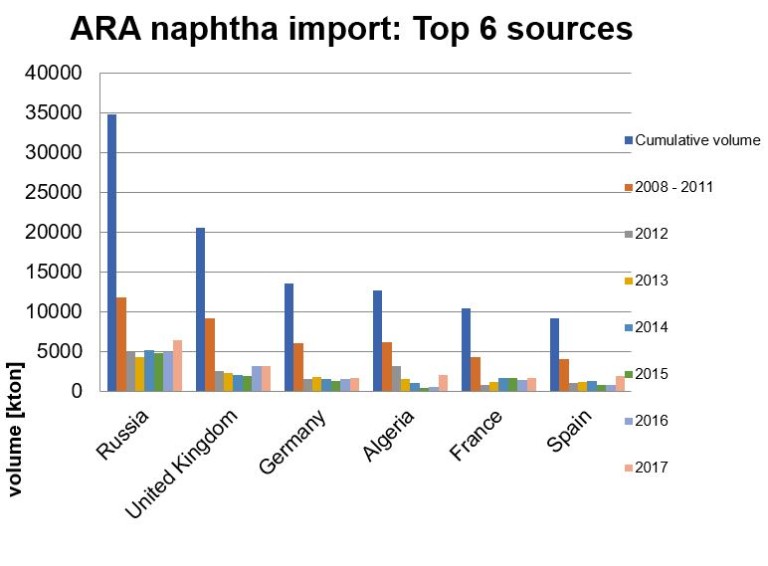
The ARA naphtha import is headed by Russia, having the biggest volume compared to the other countries with UK, Germany, Algeria, France and Spain as well in the top six sources list, as seen in the graph. This shows the reliance on near as well as less local markets of the various market participants. A shrinking imbalance is negative for the ARA tank storage sector. However, considering the market size and the option to switch to the gasoline segment the impact seems small.

PJK International provides direct insight in the market by not only its annual Tank Terminal reports, but also with weekly reports on stock levels of various products (including naphtha) stored at independent tank terminals in the ARA region, a weekly report on the trade flows up and down the Rhine river and daily barge freight rates for transport within ARA and up the Rhine. This way, we provide tools for better and quicker decision making processes.

Would you like more information ?For more information contact us at Insights Global HQ in the Netherlands.+31 (0)850 662500

Insights from our analysts

This weeks insight from Lars van Wageningen, our Operations Manager at Insights Global, also quoted by Bill Lehane (Bloomberg) considers the market is getting tight. The inland stockpiles haven’t been replenished over summer because Rhine barges haven’t been able to operate at full capacity. Furthermore even as the water levels start to recover, the Rhine barge rates remain high; also barge traffic has risen on the main river. In addition the Bayernoil Vohburg refinery outage is also adding to tightness, with suppliers in that region looking further north for supply than usual.

A quick Insight in the ARA petrochemical tank storage market.

In Northwest Europe the oil and the petrochemical sectors are leading sectors that employ thousands of people directly and indirectly within the region. The main European production cluster for liquid bulk products is made up of the Benelux countries, Switzerland and the German and French regions that are connected to the Rhine river.

The Amsterdam, Rotterdam, Antwerp region or ARA is the main trade hub that connects Europe to global markets. The petrochemical sector is responsible for producing various materials such as plastics, paints, solvents, fibres and raw materials for pharmaceutical and cosmetics sector. Taking a closer look at the petrochemical side of the cluster and the different market participants in it, many of the companies produce goods in high-volume or ‘bulk’ quantities.

Companies in this cluster have been getting more exposed to severe competitive pressure. This has been Leading to the closure of for example La Mede refinery, Reichstett refinery, Petit Couronne refinery and the Wilhemshafen refinery. Also the decision made by Gunvor to not go ahead with their investment in upgrading the GPR site is a sign of high uncertainty amongst players about what the future will bring. Despite this at the same time there are others planning expansion like Ineos, one of the leading chemical companies with sales of around 60 billion dollars and their production network spans 171 sites and 24 countries. Ineos announced that their plan will have 2.7 billion capital investment in Northern Europe.

One of the things to watch in the future and the question for all is; where will the new Ineos plant be built. According to news articles both Rotterdam and Antwerp are being considered. As Ineos already has production sites in Antwerp we give Antwerp a slightly bigger chance, but you never know what the outcome will be. Either way it is likely to boost trade in ARA, as Ethane and propane imports will increase and most likely chemicals and intermediates trade will also increase.