
Impact OPEC+ conflict and COVID-19 on Tank Storage Demand in Main Oil Hubs (part 2)

Recap last quarter blog article

In the last blog article, we explored the impact of the super contango and COVID-19 on tank storage demand in the four major oil trading hubs Amsterdam-Rotterdam-Antwerp (ARA), Houston, Singapore, and United Arab Emirates (UAE).

We concluded that the main trading hubs showed similar patterns by looking at the statistics of tanker visit numbers, marine gross trade and average berth occupancy rates, especially in the first quarter of 2020 in which the defining events OPEC+ conflict and COVID-19 evolved.

We said that in the first quarter of 2020 the number of tanker visits of the different hubs was at a minimum while the average berth occupancy rates were at their second highest since the third quarter of 2017. The low number of tanker visits was likely to have been caused by 1) high fill rate or almost full tanks of terminal operators due to contango storage play options and 2) lower consumption levels due to demand destruction by COVID-19.

The high berth occupancy rates can be explained by the fact that, despite the low number of tanker visits, in the first quarter of 2020 terminal operators were coping with the impact of IMO legislation to their business operations which might have resulted in a bit slower vessel handling at the terminals.

In this blog article we will focus on the second quarter of this year when the pandemic – in certain areas –  was at its height. We will analyze what the impact of the super contango and COVID-19 had on tank storage demand in the major trading hubs has been, individually and combined.

Tanker Hub Visits Per Quarter

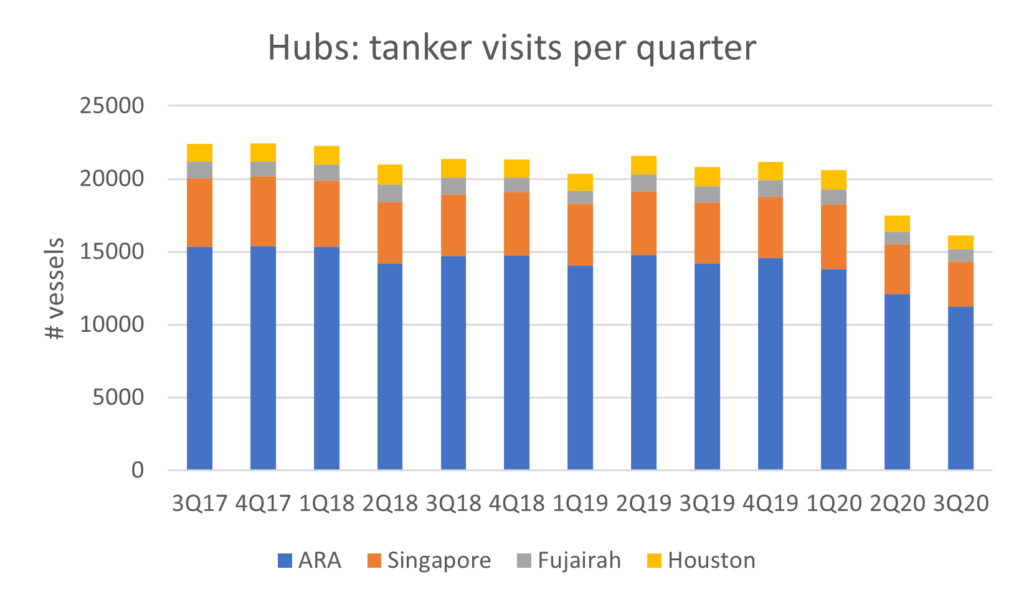
For all trading hubs consolidated the number of tanker visits dropped to a new low in the second quarter of 2020, with 13% less tanker visits compared to the previous quarter and even 19% less tank visits compared to the same quarter a year ago. Looking at the tanker visits trend (figure 1), all trading hubs show a similar trend with a continuation of the downward trend in 2020. For all hubs, with the exception of Fujairah, in the second quarter of this year the minimum value of tanker visits was reached since the third quarter of 2017. For Fujairah it was the second lowest number. The 2Q20 value for ARA was 12,184 tanker visits which is 10% lower q-o-q and 18% lower y-o-y. Singapore showed the strongest decrease in comparison with the other hubs. In the second quarter of 2020, the Asian port registered 20% less tanker visits in comparison with the first quarter of the year. The value for 2Q20 was 3,305. In relation with last year’s second quarter, the number of tanker visits was reduced with almost a quarter. In Fujairah there were 893 tanker visits seen in the second quarter of 2020. That was 19% lower than last quarter and 23% lower than the second quarter of 2019. The lowest value in Fujairah was 878 tanker visits in the first quarter of 2019. Houston registered 999 tanker visits in 2Q20. That meant 20% less tanker visits q-o-q and 22% less tanker visits y-o-y.

Figure 1: Tanker visits per hub per quarter; source TankTerminals.com

Marine Gross Trade Per Hub Per Quarter

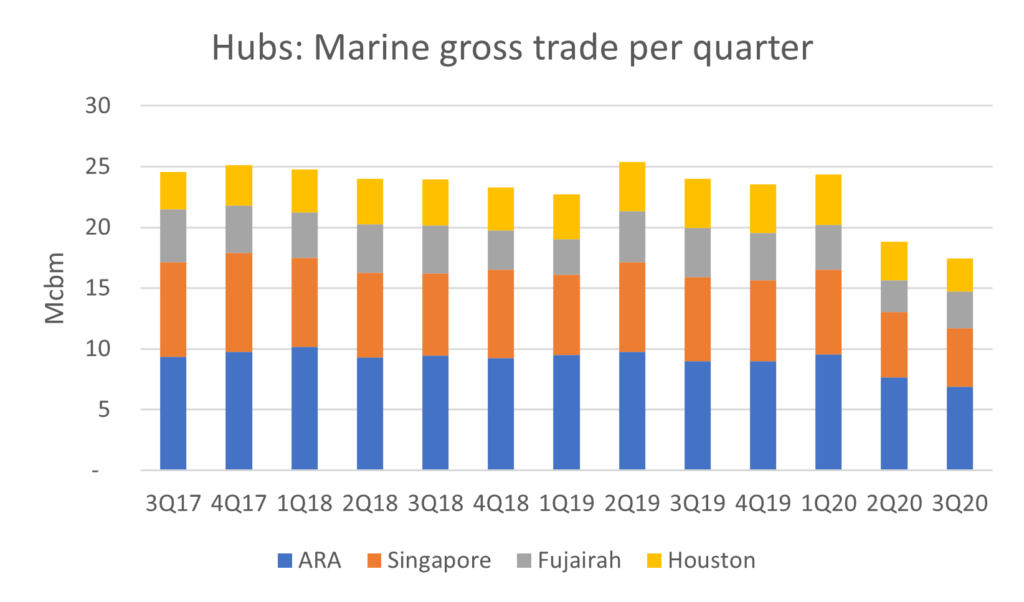
With respect to marine gross trade volumes we see a striking resemblance in the trend of the major trading hubs (figure 2). For all the hubs, it applies that marine gross trade in the second quarter of this year was at its lowest since late 2017. The 2Q20 value in ARA was 7.7Mcbm while its average volume over the last 12 quarters was 9.3Mcbm. That is a 15% drop since last quarter and a 21% drop since last year. In Singapore, the 2Q20 value stands at 5.5Mcbm while the average numbers stands at 6.9Mcbm. This is a 16% decrease q-o-q and a 25% decrease y-o-y. In Fujairah these numbers are even more substantial. The minimum value in 2Q20 was 2.4Mcbm and the average value was 3.6Mcbm. The drop compared to last quarter was 31% and compared to last year even 41%. Houston numbers stood at 2.8Mcbm in the second quarter while the average stood at 3.6Mcbm. This means a q-o-q decrease of 26% and 30% y-o-y. For the hubs combined, we saw 20% drop q-o-q and 27% drop y-o-y.

Figure 2: Marine gross trade per hub per quarter; source TankTerminals.com

Berth Occupancy Per Hub Per Quarter

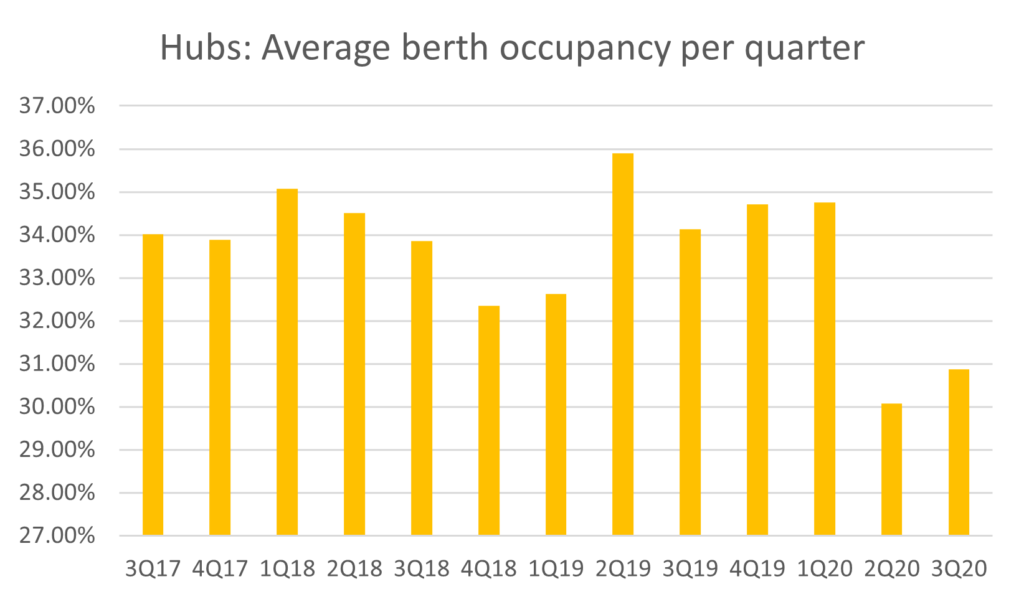
All major trading hubs showed a similar trend in berth occupancy rates in the second quarter of this year (figure 3). The rates showed a decrease compared to the last quarter while for ARA, Singapore and Houston the berth occupancy rates were at their lowest since the third quarter of 2017. For Fujairah, berth occupancy rates showed their third lowest value. The average berth occupancy in the ARA stands at around 32% while 2Q20 value stands at 31%. In Singapore and Houston these values are even more dramatic with an average berth occupancy of both hubs at 33% while the value in the 2Q20 was just below 30%. In Fujairah the average berth occupancy stands at 35.5% and the 2Q20 number was 32%. For the hubs combined we saw an average berth occupancy value of almost 31% (minimum) in the second quarter while the average stood at 33.5%.

Figure 3: Average berth occupancy per quarter; source TankTerminals.com

Stock numbers versus tanker visits

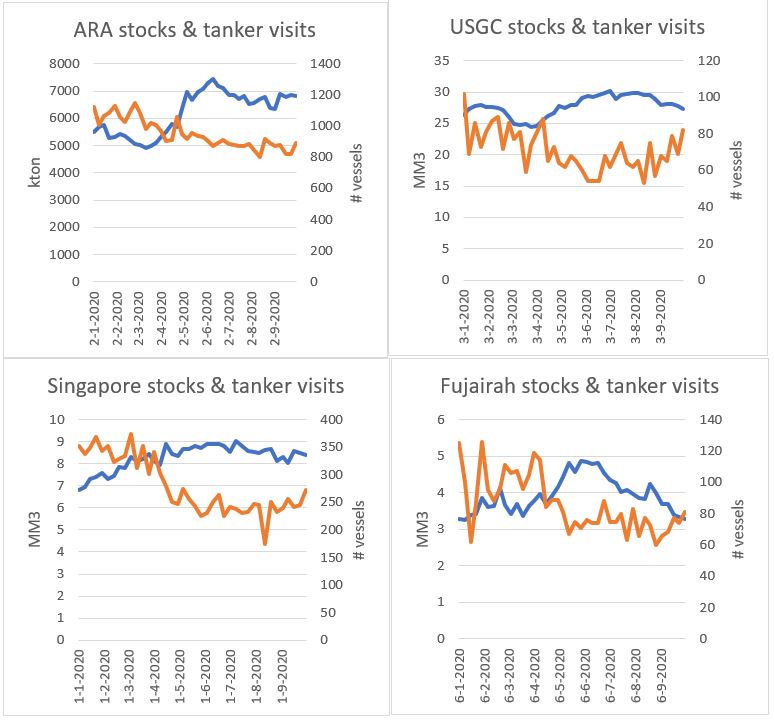
For all major hubs light end, middle distillates and heavy end stocks combined have been building this year (figure 4). The growth rate for the hubs is different but stock levels show a similar pattern and that is an upward trend. The same relation is visible for the tanker visits although a negative trend as the number of tanker visits for all hubs have been declining.

Figure 4: ARA stock levels and tanker visits; source TankTerminals.com

Conclusion

Especially for the tanker visits and marine gross trade of marine terminals it can be concluded that due the COVID-19 pandemic demand for fuels has been severely weakened which resulted in less product being moved to and from terminals. This trend was already visible in the first quarter of 2020 but accelerated in the second quarter of 2020. Intelligent lockdown, closed borders and other preventive measures in all major hubs weighed on fuel consumption and international trade flows.

The lower demand and forthcoming less international transports also led to a rise of consolidated oil product stocks in all major trading hubs. Besides less oil consumption, oil product terminals profited from the super contango which resulted in an additional build of oil product stocks. As the charts in figure 4 show, stock levels rose in 2020 while the number of tanker visits dropped. It is striking to see that all hubs show similar trends.

Berth occupancies in all hubs on the other hand dropped to their lowest since Insights Global started gathering data of terminals’ logistical performance. Also this change has been related to the COVID-19 pandemic impact. We concluded that berth occupancies rose as from the first quarter of 2019 till the first quarter of 2020 due to less efficient vessel handling operations at terminals in the run up to implementation of IMO2020 legislation. We see now that lesser ships handled by the terminals due to COVID-19 destructive demand impact weighed on terminals’ berth occupancy rates.

In general it can be concluded that the COVID-19 pandemic and the short term super contango had a hug impact on fuel demand, trade flows and storage demand, coinciding for all trading hubs. As current statistics show the virus is long from defeated and if countries do not take immediate preventive actions a second wave can be expected on the short term. This would mean that current market dynamics will persist for this and upcoming years.

About the authors and the data

The data in this report was extracted from tankterminals.com database and Insights Global’s weekly ARA Oil Product Levels publication. The data in tankterminals.com came specifically from the logistical performance benchmarking addon, which uncovers information on certain terminal performance indicators such as occupancy rates and turnaround times at berth level of a terminal. To analyze the hubs, all the berth data from the various terminals located in these specific hubs was aggregated and offered these unique insights. Tankterminals.com has data on the logistical performance dating back till the third quarter of 2017. Insights Global’s weekly ARA Oil Product Levels publication is a well-established report in the international oil trading business. Insights Global has data going back to 1995.

Jacob van den Berge has been working for Insights Global for more than 8 years and has 10 years of experience in the oil & gas industry. Currently he is the Head of Marketing and Sales but used to work as an oil market analyst and industry consultant for the company.

Contact Jacob van den Berge if you would like to discuss how our data driven company can add value to your organization by enabling intelligent decisions.

Having access to accurate, up-to-date oil storage rates is crucial to make the right business decisions.

With our Global Oil Storage Rate Report, you’ll gain access to the single and only authoritative source of storage rate information available worldwide. It will provide you with transparency on price levels in global tank storage markets regularly, so you are always in the know and can set the right ask and bid prices for your storage.

Download your FREE Sample Report now and discover what information you could have at your fingertips each quarter.

Changing biofuels regulation and the impact on terminals

The biofuel component in gasoline and diesel has been increasing slowly but surely since 2003, but changing biofuels regulation over the next few years are set to have a strong impact on tank terminals.

Tank terminals have been instrumental in facilitating the rising popularity of biofuels in the European Union. The first EU biofuels directive—to promote the use of biofuels and other renewable fuels for transport—entered into force in 2003 and set a voluntary blending target of 2% in 2005. The biofuel component in gasoline and diesel has been increasing slowly but surely since then, but changing biofuels regulation over the next few years are set to have a strong impact on tank terminals.

In November 2016, the European Commission published its ‘Clean Energy for all Europeans’ initiative. As part of this package, the Commission introduced an updated version of the Renewable Energy Directive, which defines a series of sustainability and GHG emission criteria for bioliquids. After the EU member states reached an agreement on this proposal in December 2018, the Renewable Energy Directive II (RED II) officially entered into force.

In RED II, the overall EU target for sustainable energy sources by 2030 has been set to 32%. While the Commission’s original proposal did not include a transport sub-target, the final agreement stipulates that the Member States must require fuel suppliers to supply a minimum of 14% of the energy consumed in road and rail transport by 2030 as renewable energy. Fuels used in the aviation and maritime sectors can opt in to contribute to the 14% transport target but are not subject to an obligation.

Currently, most member states are not meeting their individual targets. However, considering that the directive has to be transposed into national law by the Member States by 30 June 2021, the European Commission will soon be legally equipped to enforce the directive.

For tank terminals, this will mean a substantial shift in blending demand. Traditionally, bioethanol consumption depends on road gasoline consumption, which is expected to decrease. However, due to higher blending mandates, ethanol demand is expected to grow. Likewise, biodiesel consumption is strongly correlated to road diesel consumption.  Although diesel consumption is also expected to decrease, due to higher blending mandates we expect the demand for biodiesel to grow as well. The maximum percentage of first-generation biofuels is capped at 7%, while the rest should be an advanced / next-generation biofuel 

So while we expect the net demand for gasoline and diesel to decrease due to a variety of factors (economic recession, electrification of passenger cars and cargo vans, work-from-home), the higher blending mandates will create strong growth in demand for respectively bioethanol and biodiesel. This will offset the decline in fossil fuels and increase the demand for tank terminal blending for tank terminals.

The Renewable Energy Directive II and its impact on the fuel market make it crystal clear that biofuels should be on the radar for every tank terminal operator. During our regular Market Update webinars, we offer our expert outlook on supply, demand, and trade flows and its impact on tank storage demand.

Do you want to make sure that you never miss out on important market updates? Sign up for the next webinar today, so that you are better prepared for what tomorrow will bring.

Covid-19 and the impact on the Market Outlook and Oil terminals

Even though the Covid-19 pandemic is still in full swing, it is safe to say that the corona-virus has had a profound impact on nearly every aspect of our daily lives. Besides the more visible effects on public health, society, and transportation, Covid-19 also sent a shockwave through the global economy. 

Even though the Covid-19 pandemic is still in full swing, it is safe to say that the corona-virus has had a profound impact on nearly every aspect of our daily lives. Besides the more visible effects on public health, society, and transportation, Covid-19 also sent a shockwave through the global economy. 

This economic shockwave also had its effects on tank terminals: As soon as the true scope of the Covid-19 pandemic became apparent, the oil market shifted from a backwardated market into a deep contango. Needless to say, this contango immediately led to a significant increase in demand for tank storage. Currently, the commercial occupancy rates at oil tank terminals are very high, and as a result, tank storage rates have increased by 20-30%.

This presents a somewhat unique situation for the tank terminal market. On the one hand, high occupancy rates and increased tank storage rates have a very positive impact on the short-term profitability of oil terminals. However, the consumption of oil products has seen a sharp decline and will takes years to recover fully.

What will this mean for the tank terminal market? At Insights Global, we continuously calibrate our Advanced Tank Terminal Market Model against shifts in the market. Our algorithms take into account macroeconomic trends like oil prices, taxes, trade costs, and interest costs, and (petro)chemical factors like trade flows, logistics, and storage rates. Based on the latest economic developments, we have also incorporated the Corona effect in our forecasting models.

Even though the V-shaped consumption curve (sharp decline followed by a sharp increase) for oil products seems already behind us, we expect it will take five years for consumption levels to normalize fully. Jet-kero consumption is hit especially hard by the Corona-crisis, with an initial reduction of up to 95%. This slow recovery is not only caused by the impending economic recession, but also by the change of habits like working from home and replacing in-person meeting by online meetings.

While the current focus is – understandingly so – on the impact of Covid-19 on the oil market, other essential factors like the electrification of road transport, reverse dieselization of European passenger cars, and IMO 2020 regulation for bunker fuels will also play a key role in the tank terminal market. Naturally, the impact of these events is also incorporated in our Advanced Tank Terminal Market Model.

Having access to accurate, up-to-date oil storage rates is crucial to make the right business decisions.

With our Global Oil Storage Rate Report, you’ll gain access to the single and only authoritative source of storage rate information available worldwide. It will provide you with transparency on price levels in global tank storage markets regularly, so you are always in the know and can set the right ask and bid prices for your storage.

Download your FREE Sample Report now and discover what information you could have at your fingertips each quarter.

What lies in store?

Patrick Kulsen and René Loozen of Insights Global consider the impact of COVID-19 and IMO 2020 on bunker fuel consumption and ARA tank storage demand.

The assumption is that the current lockdown lasts three months and has a negative impact on marine fuel bunker consumption levels. After the lockdown, the consumption level will gradually normalise, which will take five years.

The real impact of COVID on global and regional GDPs is not clear yet, but we may conclude that the IMO 2020 regulation have had a positive impact on the ARA tank storage demand.

As we are now well into the second quarter of 2020 it is useful to look back on the introduction of the recent IMO legislation on the regulation of sulphur emissions from bunker fuels. The dust has settled with respect to the implementation of these new rules. But as this happened a ‘black swan’ arrived on the global oil scene: COVID-19 or the Coronavirus. This pandemic and the international crisis it evoked is gripping international trade and impacting on shipping and bunker sales like nothing we have ever seen before. So, this article will also look forward to estimating the medium-term impact on bunker markets and, in particular, on bunker storage markets.

Run-up to 2020

The International Maritime Organization’s (IMO) regulation mandating a reduction in the sulphur content of marine fuels to 0.50% or below came into effect on 1 January 2020.

Leading up to the start of this new era in marine fuels there were multiple opinions or scenarios about which bunker fuels would become dominant. In first instance, most stakeholders thought high sulphur fuel oil (HSFO) would remain a dominant bunker fuel because of the expected uptake of scrubbers. Other stakeholders assumed that marine gasoil (MGO) would become main bunker fuel as there wouldn’t be enough supply of 0.50% very low sulphur fuel oil (VLSFO). Some oil majors, the International Energy Administration (IEA) and consultants then changed their opinions, believing that VLSFO would become the dominant fuel. There were other stakeholders, like the gasoil traders, who thought that the demand for MGO would increase significantly because of IMO 2020.

The first months of 2020

The first months of 2020 have shown that VLSFO seems to be the dominant bunker fuel. Consumption of MGO increased only slightly by around +10%. HSFO accounts for about 20% of total fuel oil consumption, with the rest being mostly VLSFO.

The introduction of the new VLSFOs has led to some compatibility concerns. VLSFO blends can come from residual components and distillate components. Residual components are mostly aromatic due to the asphaltenes in the bottom of the barrel. Distillates are high on paraffins. Blending these two streams together can lead to compatibility issues. This can occur if a ship switches between different batches and the fuel is mixed in the ship’s fuel tank, a process also known as commingling. The co-mingling of bunker fuels from different origins could lead to serious damage to engines or the clogging of fuel lines. VLSFO residue blends, being more aromatic, and hydrotreated vacuum gasoil (VGO), being less aromatic have these compatibility issues.

These compatibility issues also have an impact on the demand for storage capacity as some product owners have taken steps to avoid commingling new fuels in their tanks. So, this calls for segregated tanks, which will increase demand for tanks.

An important and lucrative business for oil traders in the Amsterdam-Rotterdam-Antwerp (ARA) region used to be the transhipment of fuel oil from Russia to the Far East. However, this transit flow has largely disappeared. On the one hand, the supply of Russian fuel oil has gone down whereas the demand for fuel oil in Asia has also dropped significantly. Furthermore, Asian bunker demand for fuel oil is currently being supplied from other closer regional sources. Nowadays, Russian exports are being directly exported in smaller tankers, with the US as the main destination. The ARA is no longer the heavy fuel oil transhipment hub.

Looking ahead

Our assumption in the post-2020 era is that the shipping industry will keep on using fuel oil as the dominant marine fuel (80%) but it is unclear is what the respective shares of VLSFO and HSFO will be.

In our forecasting models, the Corona effect is incorporated. The assumption is that the current lockdown lasts three months and has a negative impact on marine fuel bunker consumption levels. After the lockdown, the consumption level will gradually normalise, which will take five years. Our assumption of five years is based on experience in the past and the enormous fall of GDP which influences the consumption of fuel oil.
The International Monetary Fund (IMF) forecasts a 3% contraction of global GDP in 2020, while the Eurozone will see a decline of 7.5% in 2020. It will take several years of GDP growth to be back at the same GDP level as in 2019. The consumption of bunker fuel is heavily correlated with global trade, so we expect it will take several years before bunker fuel market is at the same level as in 2019.

Due to growing bunker fuel consumption and declining average production, surplus in NW Europe will change into a deficit. Terminals in ARA specialising in fuel oil will benefit from the growing size of the fuel oil bunker market. As the number of grades has increased and more components are needed to blend into VLSFO / HSFO / MGO, more storage capacity is needed.

Additionally, on top of these structural effects on fuel oil supply, demand and imbalances, there is an enormous oversupply in the market due to the COVID-19 crisis. This has resulted in a steep contango in fuel oil forward prices and is stimulating traders to buy and store excess fuel oil supply. This provides major support for fuel oil storage rates in the short to medium term.

So, in summary, the introduction of the IMO 2020 regulation and the COVID-19 crisis have had the following impact:
• More tanks needed to segregate and blend fuel grades
• Less arbitrage flows limit the demand for large tanks
• Long term bunker demand growth and rising imbalances will support tank demand
• Short to medium term support of fuel oil storage rates due to steep contango.

The real impact of COVID on global and regional GDPs is not clear yet, but we may conclude that the IMO 2020 regulation have had a positive impact on the ARA tank storage demand. Also, in the short to medium term, the COVID-19 / Corona crisis has had a positive effect on the tank terminal business.

Bunkerspot article

Rene Loozen and Patrick Kulsen contributed to Bunkerspot’s June/July 2020 edition. The article contains IG’s view on the impact of the IMO 2020 and the Corona pandemic on bunker storage markets.

When you fill in this registration form, you are able to download the full article from Bunkerspot.

Register for ARA Oil Tank Terminal Sample Report

Register today, to prepare for tomorrow!


    Key learnings ARA Tank Terminal report

    Important questions that need to be answered first before choosing a strategic direction. Recent events has shown just how volatile oil markets are and justifies in-depth market intelligence that enable intelligent decision making.

    1. COVID-19: Covid-19 outbreak and its impact on oil markets.

    2) IMO 2020 and changed bunkerfuel specs: Effect on fuel oil consumption, on MGO and growing storage demand.

    3. Electrification of passenger cars: Downward effect on gasoline consumption and its positive impact on storage demand.

    4. Reverse dieselization of European passenger car sales: Change in car sales might decrease structural imbalances and negatively impact storage demand.

    Insights Global’s ARA Tank Terminal Annual Market Outlook Report will cover:

    1) Our outlook for oil products supply, demand and trade flows and its impact on tanks storage demand.

    2) Oil price forward curve outlook and its impact to tank storage markets

    3) Tank storage capacity developments

    4) Tank storage rates developments

    5) View on medium term profitability

    Themes that impact ARA Oil Tank Terminal Market

    The tank terminal market in ARA is facing several challenges and issues that influence the short- and mid-term dynamics. Oil market developments, globally and regionally, could have an impact on the ARA Oil tank terminal market.

    We have selected three main themes that impact ARA oil Tank Terminal markets in the short and medium term:

    COVID-19 outbreak: Increase in tank demand and storage fees due to massive oversupply on petroleum markets (deep contango)

    IMO 2020 and changed bunker fuel specifications: Growing ARA tank storage demand

    Electrification of passenger cars: Downward effect on road fuels consumption but mixed effects on tank storage demand

    Reverse dieselization of European passenger car sales: The change in car sales might decrease structural imbalances and lead to less demand for tank capacity

    COVID-19 outbreak

    Since the beginning of the Corona crisis the market is clearly in contango. Looking to the calendar spread it was already expected that market would move into contango on a short term. However, the Corona crisis was the big trigger for the start of the contango period. As the graph shows the market is in a deep contango and how long this situation will persist is the main question. It depends on how fast the production and demand of oil products will become in balance again.

    As we all experience the impact of Covid-19 is huge on our daily life and therefore also on our fuel consumption. The Corona effect needs to be incorporated on the forecasting models. Assumption is that the current lockdown lasts three months and has a negative impact for all fuels with the exception of heating oil. Reduction of diesel and LPG volumes are a bit lower because both diesel and LPG consumption is not limited to passengers’ vehicles. Commercial vehicles like buses and trucks don’t use gasoline fuels but usually diesel or LPG. Jet-kerosene is very much hit as almost all passenger traffic has stopped.

    Reduction lockdown

    LPG: 27%

    Naphtha: 40%

    Gasoline: 70%

    Jet-kero: 95%

    Heating oil: -20%

    Marine gasoil: 30%

    Diesel: 50%

    Fuel oil: 30%

    Reduction after lockdown in 2020

    9%

    13%

    23%

    32%

    -3%

    10%

    17%

    10%

    After the lockdown, consumption level will gradually normalise, which will take five years. However, it is unclear yet what the exact impact of Covid-19 will be on the travel behaviour of people.

    IMO 2020

    The International Maritime Organization (IMO) has implemented its global legislation to limit sulphur emissions as a result of marine fuels. The legislation calls for a reduction of the sulphur content in marine fuels to less than 0.5%, which has started January 1st, 2020. Until the start of 2020 the limit was 3.5%. The first months of 2020 show that VLSFO seems to be the dominating bunker fuel. Consumption of MGO increased only slightly by around +10%. HFO is about 15-20% of total fuel oil consumption, with the rest being mostly VLSFO.

    The consumption of bunker fuel is heavily correlated with global trade, so we expect it will take several years before bunker fuel market is at the same level as in 2019. However, terminals in ARA specialized in fuel oil will benefit from the growing size of the fuel oil bunker market. As the number of grades has increased and more components are needed to blend into the 0.5%FO / HSFO / MGO, more storage capacity is needed.

    Additionally, on top of these structural effects on fuel oil supply, demand and imbalances, there is an enormous oversupply in the market due to the COVID-19 / Corona crisis. This has resulted in a steep contango in fuel oil forward prices and is stimulating traders to buy and store excess fuel oil supply. This provides major support for fuel oil storage rates in the short to medium term.

    Electrification of passengers’ cars

    Electric mobility is growing very fast. In 2018, the global electric car fleet exceeded 5.1 million, up 2 million from the previous year. China sold over 1 million cars in 2018, followed by Europe (385,000) and US (361,000). Norway has the highest market share for sales (46% in 2018). According to the IEA the projected growth in the New Policies Scenario of electric vehicles would cut oil products by 2.5 million barrels/day.

    In a push to limit GHG emissions originating from vehicles the European Commission has imposed emission targets to car-producers. New cars are tested and need to have CO2 emissions lower than a certain limit. This limit has been gradually lowered to an average of 130 gram per kilometre in 2015 and will be lowered even further to 95 gram per kilometre as from 2021. CO2 emissions are directly proportional linked to fuel efficiency and therefore have a direct effect on consumption volumes per car per kilometre. As from 2025 the EU emission target is -15% relative to 2021. As from 2030 the target is set on -37.5% relative to 2021.

    If car manufacturers do not comply to these targets, they will get penalties because of non-compliance. As BEV’s count as zero emissions cars, it is expected that these targets drive the production of electric cars.

    However, reality is different as EU average car emissions are increasing again, see figure 5.6b. Higher SUV sales and not diesel decline have resulted in higher CO2 emissions.

    Nevertheless, this electrification trend will have an impact on the gasoline consumption. In ARA the port of Amsterdam plays a central role in the gasoline segment. Because Europe has a structural surplus of gasoline there is a continuous flow being exported out of Europe to gasoline outlets. Consumption of European gasoline is expected to decrease, mainly because the electrification of its car fleet. As the production of gasoline will not decline or not decline that fast, it is expected that the surplus of gasoline will increase, which is beneficial for terminal operators.

    Reverse dieselization of European passenger car sales

    Due to a mix of governmental policies and changes in consumer preferences the share of diesel-powered cars relative to total cars sales has shifted dramatically in Northwest Europe. Consequently, the consumption of diesel is decreasing and it is expected this trend will continue. As production of diesel will not decline or not decline that fast, the deficit of gasoil / diesel is expected to decrease, which is not beneficial for terminal operators.

    Conclusion

    Although the oil market is really hit by Covid-19, the direct impact on oil terminal operators is positive as the market is currently in a deep contango. Consequently, tanks are rented out and storage fees have increased significantly.

    Other themes like IMO 2020 and electrification of passenger cars seem to have positive effects on the profitability of terminal operators. IMO 2020 create more tank storage demand because of a higher number of bunker fuel grades and more components that are needed, while for gasoline the structural imbalance is expected to increase.

    However, for the storage demand for diesel is expected to decrease because the current deficit is expected to decrease.

    Having access to accurate, up-to-date oil storage rates is crucial to make the right business decisions.

    With our Global Oil Storage Rate Report, you’ll gain access to the single and only authoritative source of storage rate information available worldwide. It will provide you with transparency on price levels in global tank storage markets regularly, so you are always in the know and can set the right ask and bid prices for your storage.

    Download your FREE Sample Report now and discover what information you could have at your fingertips each quarter.

    Register for ARA Tank Terminal Report

    Do you want to stay up-to date with the key insights and developments you need to determine your strategy as a Tank Terminal Operator? Are you planning to invest in a tank terminal, but do you need a more in-depth understanding of the oil market dynamics and its impact on tank terminals? Do you need an outlook to make better business decisions?

    Important themes for tank terminal market in ARA are:

    1) COVID-19 outbreak and its impact on the oil market
    2) IMO 2020 and changed bunker fuel specifications: Effect on fuel oil consumption, on MGO and growing ARA tank storage demand
    3) Electrification of passenger cars: Downward effect on gasoline consumption and its positive impact on ARA tank storage demand
    4) Reverse dieselization of European passenger car sales: The change in car sales might decrease structural imbalances and has a negative impact on ARA tank storage demand

    The ARA Tank Terminal Annual Report will cover:

    1) Our outlook for oil products supply, demand and trade flows and its impact on tanks storage demand.
    2) Oil price forward curve outlook and its impact to tank storage markets
    3) Tank storage capacity developments
    4) Tank storage rates developments
    5) View on medium term profitability

    Fill in your contact details below if you would like to purchase this report which contains a unique view on current tank storage market fundamentals.